Different Types of RAM (Random Access Memory )
RAM(Random Access Memory) is a part of computer’s Main Memory which is directly accessible by CPU. RAM is used to Read and Write data into it which is accessed by CPU randomly. RAM is volatile in nature, it means if the power goes off, the stored information is lost. RAM is used to store the data that is currently processed by the CPU. Most of the programs and data that are modifiable are stored in RAM.
Integrated RAM chips are available in two form:
- SRAM(Static RAM)
- DRAM(Dynamic RAM)
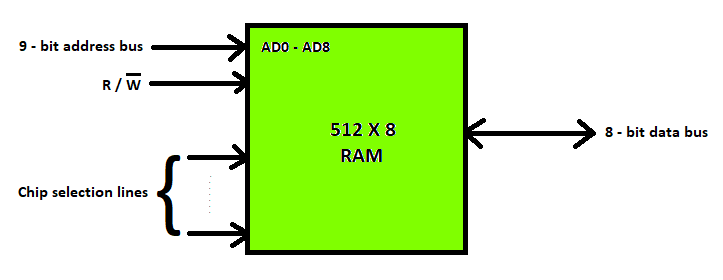
The block diagram of RAM chip is given below.
The SRAM memories consist of circuits capable of retaining the stored information as long as the power is applied. That means this type of memory requires constant power. SRAM memories are used to build Cache Memory.
SRAM Memory Cell: Static memories(SRAM) are memories that consist of circuits capable
of retaining their state as long as power is on. Thus this type of memories
is called volatile memories. The below figure shows a cell diagram of SRAM.
A latch is formed by two inverters connected as shown in the figure. Two
transistors T1 and T2 are used for connecting the latch with two bit lines.
The purpose of these transistors is to act as switches that can be opened or
closed under the control of the word line, which is controlled by the
address decoder. When the word line is at 0-level, the transistors are
turned off and the latch remains its information. For example, the cell is
at state 1 if the logic value at point A is 1 and at point B is 0. This
state is retained as long as the word line is not activated.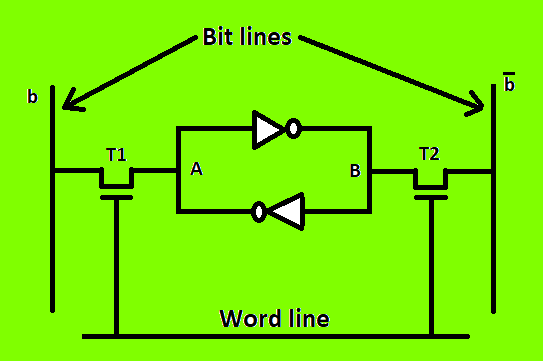
For Read operation, the word line is activated by the address input to the address decoder.
The activated word line closes both the transistors (switches) T1 and T2.
Then the bit values at points A and B can transmit to their respective bit
lines. The sense/write circuit at the end of the bit lines sends the output
to the processor.
For Write operation, the address provided to the decoder activates the word line to close both
the switches. Then the bit value that to be written into the cell is
provided through the sense/write circuit and the signals in bit lines are
then stored in the cell.
DRAM stores the binary information in the form of electric charges that applied to capacitors. The stored information on the capacitors tend to lose over a period of time and thus the capacitors must be periodically recharged to retain their usage. The main memory is generally made up of DRAM chips.
DRAM Memory Cell: Though SRAM is very fast, but it is expensive because of its every cell
requires several transistors. Relatively less expensive RAM is DRAM, due to
the use of one transistor and one capacitor in each cell, as shown in the
below figure., where C is the capacitor and T is the transistor. Information
is stored in a DRAM cell in the form of a charge on a capacitor and this
charge needs to be periodically recharged.
For storing information in this cell, transistor T is turned on and an
appropriate voltage is applied to the bit line. This causes a known amount of
charge to be stored in the capacitor. After the transistor is turned off, due
to the property of the capacitor, it starts to discharge. Hence, the
information stored in the cell can be read correctly only if it is read before
the charge on the capacitors drops below some threshold value.
Comments
Post a Comment